

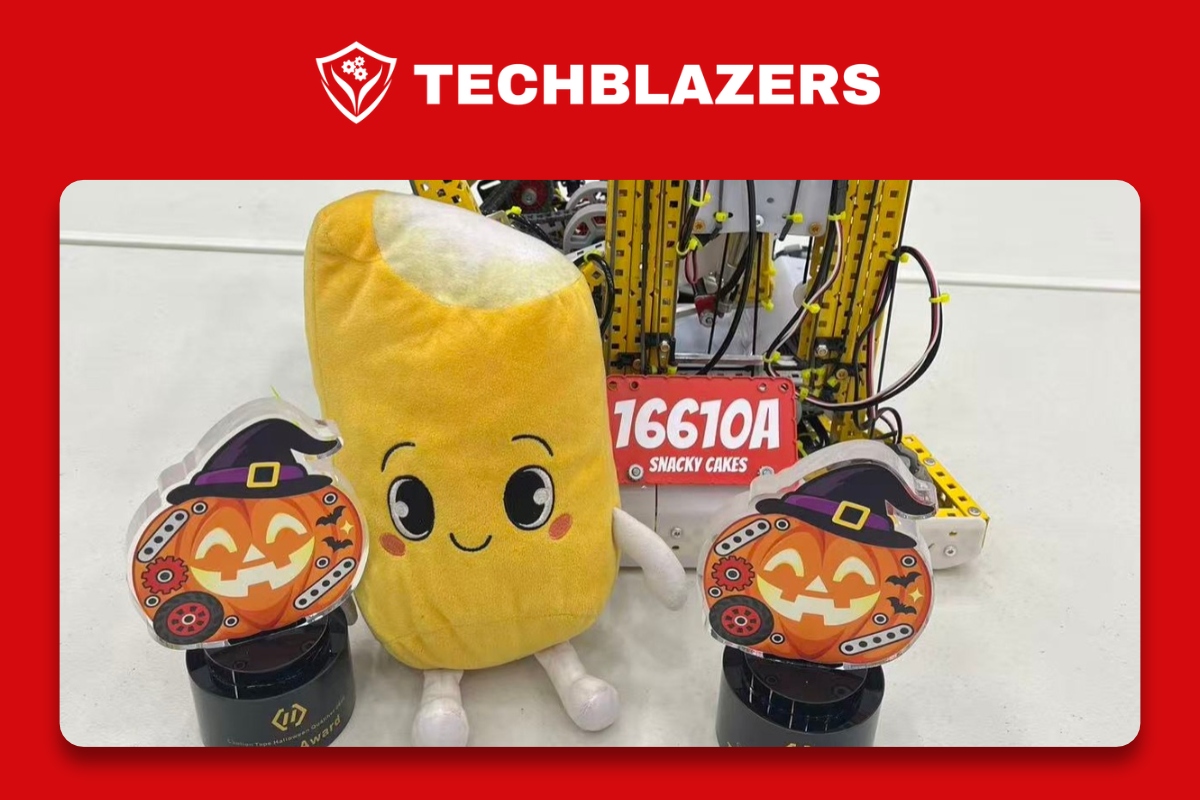

On October 31, 2026, the Caution Tape VEX V5 Robotics Competition Halloween Qualifier took place at the Markham Pan Am Centre in Markham, Ontario, Canada. TechBlazers’ two VEX V5 teams, 16610A Snacky Cakes and 16610G Good Gravy, demonstrated strong engineering skills, teamwork, and competitive performance throughout the event.
At this qualifier, 16610A earned two major honours: Tournament Champions and the Design Award. Even more impressively, the team returned to competition with its first-generation robot after two months without robot training and still delivered an outstanding performance.
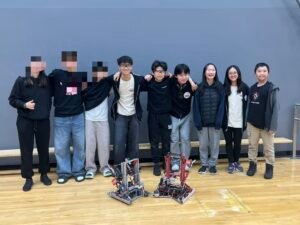
Meanwhile, 16610G continued to make progress, joining 16610A in the semifinals. The performances of both teams highlighted the technical foundation, competitive experience, and continued development of TechBlazers’ VEX V5 program.
Competition Overview
- Competition: Caution Tape VEX V5 Robotics Competition Halloween Qualifier
- Date: October 31, 2026
- Location: Markham Pan Am Centre, Markham, Ontario, Canada
- Competition Type: VEX V5 Robotics Competition Qualifier
This event was part of Ontario’s VEX V5 competition season. Teams compete throughout the season for opportunities to qualify for the Ontario Provincial Championship.
VEX V5 is a robotics competition program designed primarily for middle and high school students. Teams must design, build, program, and test robots to complete tasks defined by the season’s game rules, then compete against other teams in a dynamic match environment.
Beyond on-field performance, VEX V5 places considerable emphasis on engineering design, technical problem-solving, strategic thinking, and collaboration. Every competition provides students with an opportunity to test their ideas, identify areas for improvement, and gain valuable hands-on experience.
1. 16610A Snacky Cakes: A Strong Return to Competition
TechBlazers 16610A Snacky Cakes delivered an impressive result at the Halloween Qualifier, earning two prestigious recognitions.
🏆 Tournament Champions
🏅 Design Award
These achievements recognize both the team’s competitive performance and the quality of its engineering design.
In robotics competitions, success depends on much more than hardware specifications. Preparation, program reliability, match strategy, driving coordination, and a thorough understanding of the robot all contribute to a team’s performance.
In a live competition environment, students must make decisions under pressure, respond to changing match conditions, and execute their strategies within a limited amount of time.
What makes 16610A’s achievement particularly noteworthy is that the team competed with its first-generation robot after a two-month break from robot training and still secured the Tournament Championship and Design Award.
This result reflects the value of accumulated technical knowledge, thoughtful engineering decisions, and competition experience. A competitive robot matters, but so does the team’s ability to understand its design, work confidently with its systems, and translate that knowledge into effective performance on the field.
A well-deserved result for TechBlazers’ experienced team!
2. 16610G Good Gravy: Steady Progress and a Semifinal Appearance
While 16610A celebrated its double award, 16610G Good Gravy also delivered a performance worth celebrating.
At the qualifier, 16610G advanced to the semifinals, joining its fellow TechBlazers team, 16610A, at that stage of the competition. Seeing two teams from the same robotics program reach the semifinals made for an exciting moment and gave students valuable experience competing at a high level.
For a developing team, every competition brings new challenges and learning opportunities. How can the robot operate more consistently? Which mechanical structures or programming routines could be improved? How should the team assess match conditions and adjust its strategy in real time?
These questions are best answered through a combination of structured training, practical experimentation, and competition experience.
We congratulate 16610G on its progress and look forward to seeing the team apply what it learned at this event to future competitions.
3. VEX V5 Robotics: More Than Building a Robot
On the VEX V5 competition field, the robot is at the centre of the action. However, a team’s long-term success depends on much more than the machine itself. Engineering thinking, technical understanding, and teamwork are equally important.
From the initial design concept to mechanical construction, programming, testing, and refinement, students must continually evaluate their ideas, analyse problems, and develop practical solutions.
Engineering Design and Iteration
A robot rarely reaches its ideal performance level in a single build. Teams must test mechanical structures and robot behaviour, identify weaknesses, and refine their designs based on observations and results.
This iterative process helps students understand how engineering decisions affect real-world performance.
Programming and Systems Thinking
Robot operation involves motor control, sensor integration, programming logic, and coordination between different subsystems. Students learn to connect code with physical robot behaviour, diagnose unexpected results, and improve performance through systematic testing.
Strategy and Adaptability
Competition conditions are not always the same as training conditions. Teams must understand the game rules, develop effective match strategies, evaluate changing situations, and make adjustments when necessary.
Teamwork and Communication
From regular training sessions to competition day, students work together to share ideas, divide responsibilities, analyse technical challenges, and pursue common goals.
These abilities do not develop overnight. They grow through repeated cycles of designing, building, testing, competing, and reflecting on results.
Building Skills Beyond Competition Results
At TechBlazers, competition results are important milestones, but they are not the only measure of success.
More importantly, we want students to develop a solid engineering foundation, strengthen their independent problem-solving abilities, and become capable of designing, programming, testing, and improving their own robots.
Through sustained practice and hands-on learning, students can gradually develop the technical knowledge, confidence, and collaborative skills needed to tackle increasingly complex engineering challenges.
Every competition is an opportunity to evaluate what we have learned—and a starting point for what comes next.
Congratulations to 16610A Snacky Cakes and 16610G Good Gravy on their performances at the Caution Tape VEX V5 Robotics Competition Halloween Qualifier!
We look forward to seeing our TechBlazers teams continue to explore, innovate, and improve throughout the 2026–2027 VEX V5 season.