

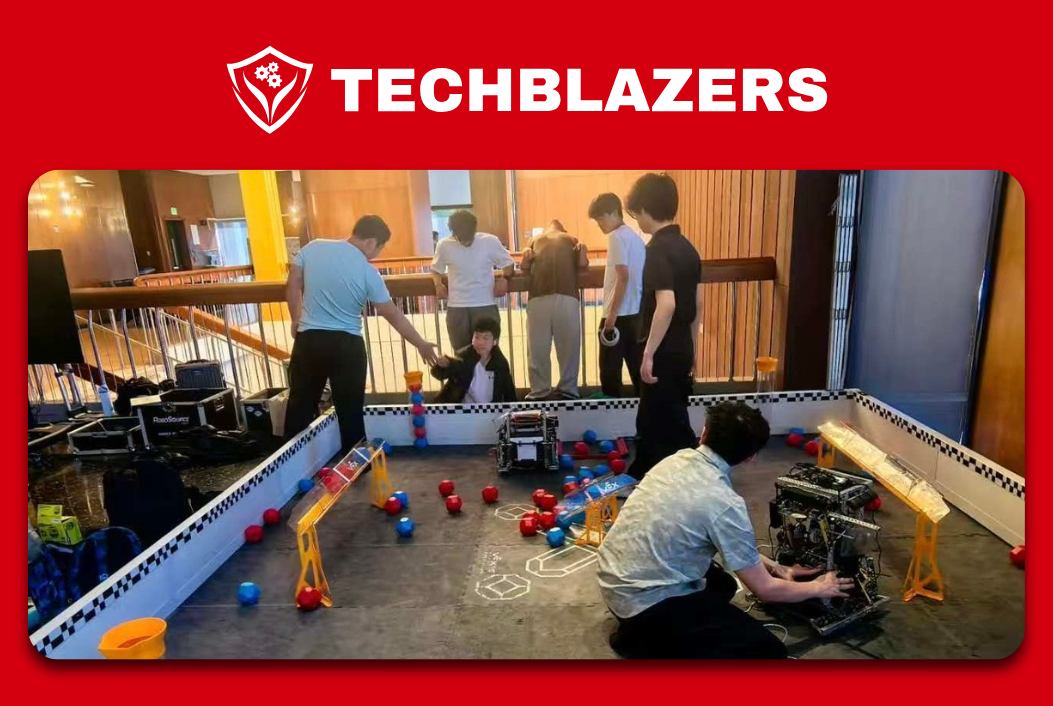

We are deeply honored to announce that at the VEX AI World Championship held at the University of California, Berkeley (USA), VEX Robotics officially established a brand-new award on-site — the Robot Intelligence Award — based on the evaluation of Team 16610A (Level 5) and their outstanding system performance throughout the competition.
This inaugural award was presented to Team 16610A, recognizing their exceptional achievements in robotic system design and autonomous performance.
Importantly, this award did not exist prior to the event. It was created during the competition itself, as VEX officials observed that the team’s performance in autonomous system architecture and real-time decision-making exceeded the scope of existing award categories.
To the best of current public knowledge within VEX/REC records, there has been no prior instance at the World Championship where a new award category was created specifically in response to a team’s technical contribution and then immediately awarded as its first recipient. This makes the establishment of the Robot Intelligence Award a uniquely significant moment in the history of the competition.
On-Site Recognition and the Birth of the Award
During the event, VEX Robotics co-founder Bob Mimlitch and the engineering team engaged in direct discussions with our team and conducted an in-depth review of the system.
Following this evaluation, the official team concluded that the autonomous capabilities demonstrated by 16610A were not fully represented within the existing award framework.
As a result, VEX Robotics introduced a new award category:
Robot Intelligence Award
This award recognizes teams demonstrating outstanding performance in:
- Autonomous decision-making capabilities
- Environmental perception and understanding
- Navigation and path planning
- AI-driven system design and implementation
System Design Overview of Team 16610A
Team 16610A’s approach is centered around the concept of full-stack robotic system intelligence, with the goal of building an autonomous system capable of real-time decision-making based on live field conditions.
The overall system consists of the following modules:
- On-field object detection and localization system
- Robot localization and multi-sensor fusion system
- Dual-robot autonomous decision-making and coordination system
- Inter-robot communication system
- Real-time path planning system
- Decision simulation and testing framework
- Motion execution and control system
Object Detection System
The system uses a YOLO-based model trained on custom-collected datasets.
To meet real-time competition requirements, inference is optimized using TensorRT INT8, significantly improving runtime efficiency while maintaining accuracy.
Localization and Sensor Fusion
The robot uses VEX GPS as the primary positioning module, supplemented by sensors on both sides of the robot to reduce blind spots.
To improve stability, an EMA (Exponential Moving Average) filtering algorithm is applied to reduce GPS noise. In addition, data from IMU sensors and tracking wheels are fused to enhance overall positioning accuracy and consistency.
Autonomous Decision-Making System
At the decision-making level, a hybrid framework combining Simulated Annealing and Monte Carlo Tree Search (MCTS) is implemented.
The system dynamically selects strategies based on real-time match conditions, including:
- Scoring execution strategies
- Defensive and interference strategies
- Resource acquisition strategies
- Match pacing and endgame decisions
A unified action space design enables coordinated decision-making between two autonomous robots within a single system.
Dual-Robot Communication System
A real-time communication system is built using a Jetson Nano Wi-Fi hotspot and UDP broadcast protocol, enabling low-latency data sharing between two robots and supporting basic cooperative autonomy.
Path Planning System
The system integrates A and DFS algorithms* to enable real-time path planning and obstacle avoidance based on both detected dynamic obstacles and known field geometry.
Decision Simulation System
A dedicated visualization UI tool was developed to simulate different match scenarios (such as varying object distributions) and evaluate how parameter changes influence system behavior, improving robustness and strategic performance.
Motion Control System Design
Match actions are decomposed into standardized motion primitives. Built on LemLib, these primitives form a modular action library that allows flexible composition across different scenarios, enabling structured and reusable motion control.
Engineering Effort and Development Cycle
Over the past six months, Team 16610A has invested significant effort into system development and iteration, dedicating approximately 30–50 hours per week to design, testing, and validation.
All development processes have been carefully documented in engineering notebooks.
At the competition, the team also engaged in technical discussions with the VEX engineering staff and demonstrated the full system architecture and implementation in detail.
Recognition at the VEX V5 World Championship
Previously, Team 16610A achieved one of the highest results in Canada over the past decade at the VEX V5 Robotics World Championship, earning:
- World Finalist (2nd Place)
- Create Award
- Division Champion
In the traditional VEX V5 competition environment, the team demonstrated strong and consistent performance in mechanical design, systems engineering, and match strategy.
VEX V5 × VEX AI: Two Parallel Capability Systems
Team 16610A competes across two fundamentally different competitive domains:
VEX V5 (Engineering System)
Focused on:
- Mechanical design and structure
- Control optimization
- Match strategy and stability
- Team execution and coordination
VEX AI (Intelligence System)
Focused on:
- Autonomous decision-making
- AI system architecture
- Perception and understanding
- Multi-robot collaboration intelligence
Together, these two domains form a rare dual-competency structure: a team that combines traditional engineering excellence with advanced AI-driven autonomy exploration.
We have always believed that robotics competitions are not only about completing tasks, but about continuously approaching a more complete and realistic engineering system.
Over the past seasons, Team 16610A has continuously iterated and refined its robot design and system architecture, gradually pushing the boundaries of what is possible within competitive robotics.
In many ways, the team has contributed new ideas to the broader VEX community, reaching a level of maturity that approaches the upper limits of current competition frameworks while still maintaining significant room for further exploration.
Moving forward, Team 16610A will continue to compete in VEX V5 and other advanced robotics platforms, further developing system-level engineering approaches and evolving from isolated optimizations toward fully integrated, end-to-end robotic intelligence systems.